
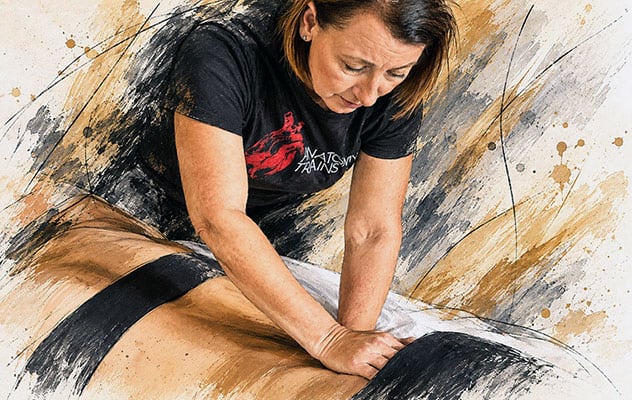
Listening Touch – Moving beyond the “No Pain, No Gain”
BY JULIE HAMMOND
I thought that, in our industry, we had finally moved beyond the “no pain, no gain” era.
But social media tells me we clearly haven’t.
We’ve all been there in our early years, wanting to do too much, working too hard, using too much pressure and not really listening with our hands.
But with experience, you learn, you refine. Or at least, you should.
So ask yourself honestly are you listening or doing?
One of the hardest things I find in clinical practice is helping clients understand that they are in control of their body and their session. And that treatment doesn’t need to hurt to be effective. We can work deeply without bullying the body. In fact, when a client feels safe, when they trust us and when their body isn’t bracing against what we’re doing, we can work with the tissues more effectively. For me, safety and trust are fundamental to good clinical practice.
I work with clients through a fascia and Structural Integration lens, but fascia is only one part of the person in front of me, just as technique is only one part of the therapeutic experience. It is so much more than a series of techniques.
I want to know their story.
What is their body telling me through their posture, patterns and movement?
How is their nervous system responding?
How does their tissue respond to my touch?
What happens when I change my pressure, speed or direction?
Am I relaxed in my touch?
What words do I need to use or perhaps not use to support them?
What words create connection and allow the body to ease and respond to my touch?
And, importantly:
Do they feel safe?
Safety isn’t simply the absence of harm. It is something we actively create within the relationship between practitioner, client and environment through trust, communication, consent, predictability, boundaries and choice.
We don’t only work with a body; we work within a relationship.
Before we ask someone to allow us into their physical space, particularly around the pelvis, abdomen or other vulnerable areas, we need to create an environment in which they retain control over their body.
Consent isn’t simply the “yes” at the beginning of a session. It continues throughout the treatment. We can explain what we’re doing. We can check in. We can offer choices around positioning, clothing and draping. We can adjust our pressure. We can ask permission before moving into another area. And we can make it genuinely okay for someone to say, “Stop.” It is important to always have this conversation; they are in control and can stop the technique at any point in the session. Consent is a conversation, not a signature.
“Sometimes the most skilled thing our hands can do is less.”
– Julie Hammond
Creating an environment in which the body feels safe enough to be listened to
- Does the person feel safe?
Not just physically safe, but comfortable, respected and understood. - Do they trust me?
Trust develops through competence, consistency, boundaries, communication and behaviour. You can have the best technique in the world, but it won’t get you anywhere if you don’t have trust. - Do they have choice?
Position, clothing, draping, touch, pressure, the area being treated and whether treatment continues at all. Are you checking in throughout the treatment. - Are we collaborating?
This to me is so important, I’m not doing something to them, I don’t “fix”. We’re working together. - Am I listening?
Not simply with my hands, to every nuance and clue the client signals. I’m observing their breathing, movement, facial expression, language, hesitation and feedback. I’m feeling how their tissues respond rather than deciding in advance what their body needs.
If I am imposing my own story on them, bullying the tissues, using too much pressure, how can I feel what their body is trying to tell me. Perhaps moving beyond “no pain, no gain” isn’t about using less pressure. It is about changing the relationship we have with the person on the table. From doing to towards working with. From imposing a technique towards listening and responding. From believing that deeper means harder towards recognising that depth can also come from sensitivity, patience and trust.
Because ultimately, good touch isn’t just about what my hands can feel.
It’s also about what the person underneath my hands feels.
Less Is More.