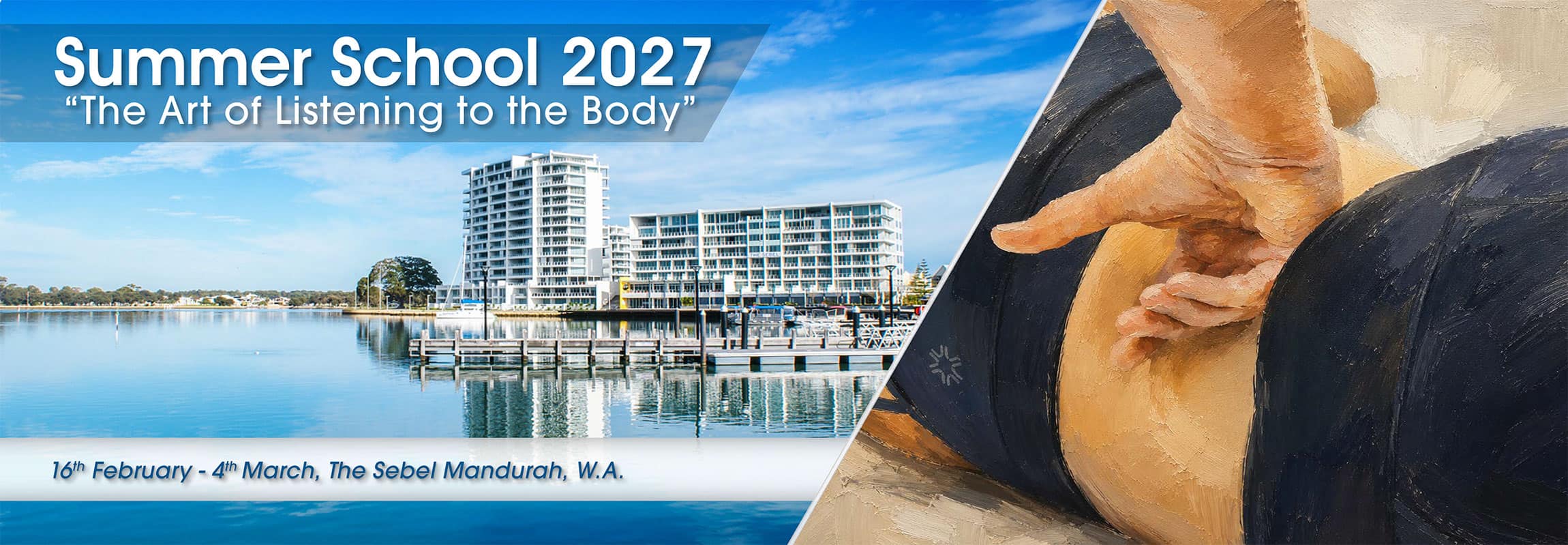
The beautiful Mandurah waterfront near Perth – there is no better place to re-set and revitalise with 17 nourishing days filled with invaluable learning from internationally renowned trainers, transformative experiencing as well as quality time for your body, mind and spirit.
NOTE: A pre-workshop morning exercise class, morning tea,
lunch, and afternoon tea is included for all workshops.
Closed Chain Biomechanics
16 February 2027 with Gary Ward
For manual and movement health practitioners
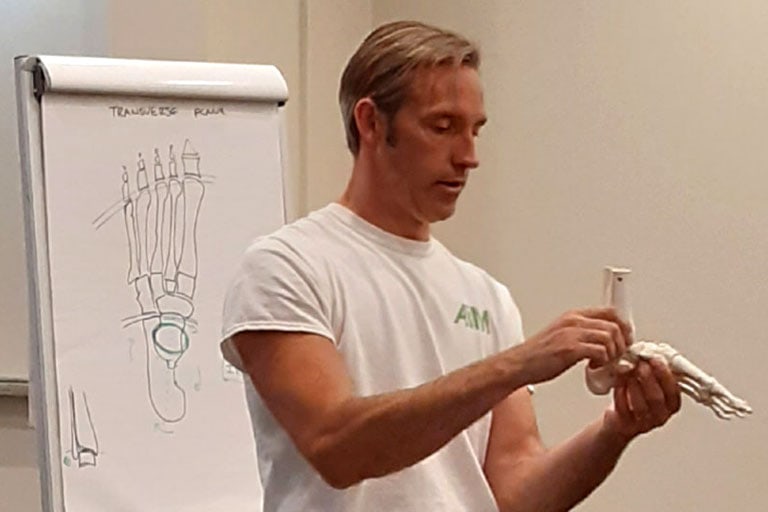
GARY WARD
Gary Ward is the creator of Anatomy in Motion and inventor of the Flow Motion Model.
ONE DAY WORKSHOP
This workshop includes a detailed tour of your body’s three dimensional anatomy from toe to head, and an introduction to Gary’s Anatomy in Motion.
Your body functions differently when it is upright and in motion compared to laying on a table. It brings to life long chains of movement integrating joints and connecting the dots throughout the whole kinetic chain.
All of the detail covered in this one day workshop sets you up perfectly for the two-day Flow Motion Model workshop that follows.
See how your integrated joint motion fits perfectly with your understanding of the Anatomy Trains.
1-DAY WORKSHOP: $579
The Flow Motion Model
17 – 18 February 2027 with Gary Ward
For manual and movement health practitioners
GARY WARD
Gary Ward is the creator of Anatomy in Motion and inventor of the Flow Motion Model.
TWO DAY WORKSHOP
This workshop will bring Gary’s Flow Motion Model to life, offering a detailed description of the journey of every single bone and joint in the body through a single footstep that lasts 0.6 to 0.8 seconds.
That’s a lot going on… and we break it down using the Closed Chain Biomechanics information from day one, to create a map of human movement that we can later use in our therapeutic processes.
What if told you, there are only eight body shapes and two leg shapes that we need to concern ourselves with to fully break down and understand human movement?
2-DAY WORKSHOP: $1,100
EARLY BIRD OFFER: Register for $1,000 before 17 September 2026
Bone Work
16 – 19 February 2027 with Wojtek Cackowski
Held at Seashells Mandurah – 16 Dolphin Drive, Mandurah

WOTJEK CACKOWSKI
Wojtek Cackowski is a certified practitioner of Structural Integration ATSI, with an educational background in sports education and physiotherapy.
FOUR DAY WORKSHOP
This immersive four-day workshop is based on the pioneering work of Sharon Wheeler, exploring the remarkable fascial plasticity of bone.
Having taught extensively alongside Sharon Wheeler, Wojtek Cackowski brings a deep understanding of BoneWork while adding his own distinctive teaching style, clinical insight, and years of practical experience.
Bone Change
Bone Change techniques, much like ScarWork, focus on restoring shape, contour, and functional movement.
Using precise, gentle manual pressure directed into the fascial layers surrounding the periosteum (the outer membranous covering of bone), these techniques address the connective tissue changes that can occur following injury or trauma.
During the healing process, calcified fascial thickening may develop around bone, altering alignment, restricting movement, and contributing to long-term dysfunction.
Bone Change techniques work to soften these mineralised connective tissue restrictions, often allowing longstanding distortions to normalise within minutes. As with ScarWork, the changes are frequently immediate, profound, and appear to be long-lasting.
Bone Rolling
Bone Rolling techniques focus on releasing adhesions between adjacent bones at the level of the periosteal fascia.
Through carefully directed manual pressure into these connective tissue adhesions, bones that have become restricted following accidents, injuries, or repetitive strain can regain their natural relationship with one another.
Once freed, the bones are able to move, unwind, or “roll” back into a more balanced position within the surrounding fascial network, often resulting in significant improvements in mobility, structural organisation, and function.
Bone Rolling is entirely a soft tissue approach. It does not involve joint manipulation, chiropractic techniques, or high-velocity adjustments. Instead, it offers a gentle yet highly effective method for facilitating lasting structural change through the body’s fascial system.
4-DAY WORKSHOP: $1,850
Introduction to ZOGA Movement
20 – 22 February 2027 with Wojtek Cackowski
For physiotherapists specialising in various fields, from sports medicine, trauma and conservative orthopaedics; movement and manual therapists; massage technicians; movement trainers and teachers; yoga and fitness instructors.
Held at Seashells Mandurah – 16 Dolphin Drive, Mandurah
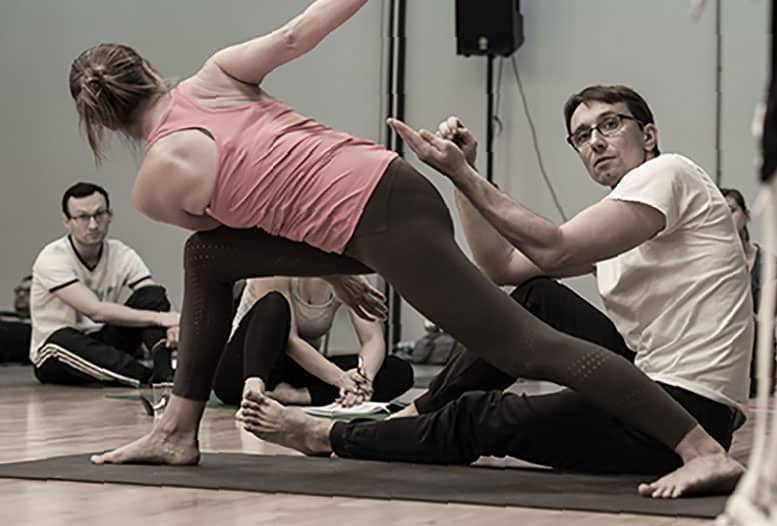
WOTJEK CACKOWSKI
Wojtek Cackowski is a certified practitioner of Structural Integration ATSI, with an educational background in sports education and physiotherapy.
THREE DAY WORKSHOP
During this training, participants will become familiar with the basic principles of the Zoga Movement method. They will be introduced to the concept of relative tissue movement and its impact on the chain reactions in joints that determine the possibility of free movement. They will also learn the basics of postural analysis and biomechanical analysis of the body in motion.
The next step will be to experience how, through carefully designed movement sequences, they can achieve changes in the body’s spatial organisation in gravity and restore greater movement potential in their own and their patients’ bodies.
Additionally, training participants will become familiar with effective manual and movement support techniques that will help them achieve local and global changes in the biomechanical system of their patients’ bodies.
Zoga Movement is a new way of thinking about the biomechanics of the human body and how movement affects the relationship between all anatomical structures and each other and gravity. It’s a concept that begins with assessment, moves beyond limitations, and increases the ability to care for every aspect of the body.
Zoga is a therapeutic concept developed by Wojtek Cackowski. It is a method based on movement supported by manual interventions, aimed at anyone who wants to achieve freedom and awareness of movement and posture in all dimensions, experiencing it in its full form. It tests all possible relationships between the body and gravity and creates multiple global and local movement vectors available within the body.
It uses the Anatomy Trains map to guide the process of biomechanical interventions around the tensegrity fascial system.
Yoga asanas are functional tests and postures that induce different vectors of traction between different fascial layers. Zoga is designed to support and achieve the goals of structural integration and create lasting pattern change in the organisation of the myofascial system in the human body.
Zoga can take the form of:
- an individual journey through self-exploration and experiencing the development of one’s own body through the process of self-education,
- practicing in the form of group movement classes with a Zoga Movement Method Instructor,
- individual therapy in the form of a one-on-one session with a Certified Zoga Movement Therapist
Zoga Multidimensional Movement is a practical training where you will experience and learn:
- the ability to read the body and find limitations in tissue sliding
- using and directing movement to achieve efficient and balanced functioning in gravity to achieve balance and minimise energy consumption
- the ability to perform effective manual interventions that restore the free movement of fascial layers relative to each other.
During the Zoga Multidimensional Movement training you will learn:
- how the individual layers of fascia influence each other
- how the fascial bands run according to the Anatomy Trains concept
- how anatomical bands and their components react to stretching, tension and traction
- how individual asanas produce stretching of the anatomical band elements and create slippage between specific tissue layers
- how to use postural and functional assessments that lead to the creation of treatment strategies
- how to help clients and patients find movement in areas where it has stopped
- how to use manual interventions to help restore proper sliding between layers of anatomical tapes.
3-DAY WORKSHOP: $1,550
EARLY BIRD OFFER: Register for $1,300 before 17 September 2026
Navigating and Nourishing the Nervous System: A Polyvagal Perspective
20 – 22 February 2027 with Melanie Burns
For manual and movement therapists
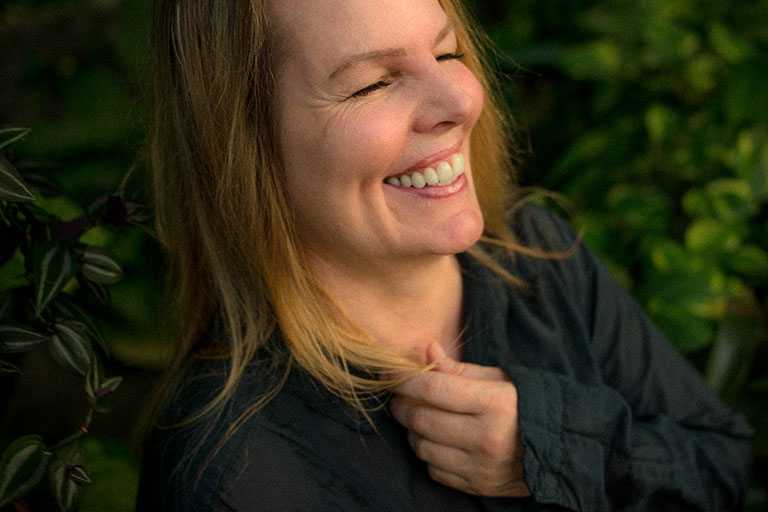
MELANIE BURNS
Melanie Burns is the Chief Executive Officer of Anatomy Trains and Director of Anatomy Trains Europe and UK.
THREE DAY WORKSHOP
In this rich 3 day course, we will explore the ways our autonomic intuition shapes our experience of ourselves, each other, and the world, and how the organising principles of polyvagal theory can come alive in manual and movement therapies.
Through vibrant anatomical lectures, experiential exercises, demonstrations, and reflective conversation, you will develop the vocabulary and skill to tend and befriend your own nervous system with the opportunity to use knowledge in your manual or movement practice.
We will begin with the anatomy of the 12 cranial nerves, with a focus on the “vagabond” or vagus nerve, including which nerves are sensory, motor, and which are both, with grounding experiential exercises you can use for yourself and with your clients, or in classes.
We will then cover the organising principles of the polyvagal theory including the hierarchy, neuroception, and co-regulation, and how these principles help shape relationships.
You will leave with a better understanding of your own autonomic mapping, tracking state shifts, and learn to bring polyvagal informed language and interventions into your work.
The main focus will be on discovering and deepening pathways to ventral regulation.
Through experiential practices, self massage, breathwork, and other tools, you will identify the conditions that invite or inhibit regulation, and develop sustainable practices that support safety, resilience and regulation.
3-DAY WORKSHOP: $1,550
EARLY BIRD OFFER: Register for $1,300 before 17 September 2026
When The Body Speaks: Reading Patterns for Fascial Resilience and Autonomic Balance
24 – 26 February 2027 with Thomas Myers
For manual and movement therapists

THOMAS MYERS
Thomas Myers is Global Director of Anatomy Trains.
COMMENTS FROM A 2023 STUDENT:
“See the adjustment you made on me in such a short time, I spent the last 30 years trying to fix. I had this inner anger which is now gone/dissipated, and I feel way more at ease.
Now when I look at people, I don’t just see their mechanics, but I see the underlying state they’re stuck in. Almost like how their brain is locked. I also feel so much calmer.
Thank you for releasing this state in which I was trying so desperately to find.”
THREE DAY WORKSHOP
This course in visual assessment is designed for the working professional as a skill-builder. And it is also open to all who negotiate modern life in a body.
So, whether you want to build your professional skills, explore your own unique pattern, or some combo of the two, come to beautiful Western Australia to explore greater inner ease, vitality, and freedom of movement with Anatomy Trains author and school-founder, Thomas Myers.
Gain insights regarding your own soft tissue patterns through Thomas’ holistic approach in seeing and understanding body patterns. Leave with invaluable information to strengthen your somatic resources, and self-development strategies on how to enhance dynamic balance and inner lift.
Not to mention that you will never be bored in airports again – once you start looking of patterns of posture and gait, people watching becomes endlessly fascinating.
In this course, Thomas synthesises 50 years of teaching and therapy practice into applicable insights from recent research and ancient knowledge.
You will gain skill in seeing – both skeletal and more psycho-spiritual, as well as practical demonstrations of hands-on myofascial releases and self-help movement practices.
Fascial Tensegrity: the stability / mobility equation and lifelong emotional learning
BodyRead postural patterns via skeletal relationships
Fascia as a sensory organ: the basis for proprio-, intero-, and nociception
Mechanoreception: the ‘sixth sense’, sensitivity and physiological response
Autonomic regulation: emotion, traumatic ‘memory’, and immunity
‘Core support’: The ‘hip grip’ and thoracolumbar fascial membranes in back pain
The language of movement underlies all our feelings and verbal communication. ‘Kinese’ is everyone’s first language in our infant years. We initially speak and listen through our kinaesthetic sense. For those who can see, it is still speaking through you now.
Come, learn and have fun with the art and craft of sensing how body patterns ‘speak’.
3-DAY WORKSHOP: $1,550
EARLY BIRD OFFER: Register for $1,300 before 17 September 2026
Spinal Dynamics: Advanced Soft-tissue Approaches to 3-D Spinal Movement
27 – 28 February and 1 March 2027 with Thomas Myers
This course is definitely for hands-on professionals.
It presumes familiarity with anatomy vocabulary and spinal palpation. A minimum of 2 years clinical experience is preferred, but not required to attend.
THOMAS MYERS
Thomas Myers is Global Director of Anatomy Trains.
THREE DAY WORKSHOP
Go beyond ‘work on the painful bits and strum the tough cables’. Take a deeper dive into the dynamics of the human spine, expertly guided by Tom Myers’ 50 years of manual therapy teaching.
The spine is that wonderfully adaptive central armature of the human form, and it works the best in length, when the vertebrae are allowed to ‘float’. How do we get there?
Based on Thomas’ groundbreaking Anatomy Trains map of myofascial meridians, we will delineate the soft-tissue patterns around the vertebrae from the superficial sheets to the erector cords to the deep intersegmental rotators and sacral multifidus.
Anteriorly, learn to use the muscles that attach body / disc ‘column’ – pelvic floor, piriformis, psoas, QL, diaphragm and longus muscles – to affect the primary and secondary curves.
THIS COURSE COVERS:
BodyReading clients’ spinal positioning to assess skeletal symmetry and develop strategies for the resolving soft tissue patterns
Learn Fascial Release Techniques – fully laid out for intent and ‘feel’, with immediate application in your practice. (We do not teach HVLA thrusts, but we do teach deep and nuanced soft-tissue work that will support chiropractic or osteopathic work.)
The 3 rotational systems of the spine – breath and functional movement patterns through the spine. Techniques for lordosis and kyphosis, side bends, and deep attention to assessing and correcting spinal rotations.
The ‘Hip Grip’ – the lowest spinal muscles – obturator internus, piriformis, and levator ani
Thoracolumbar rotations, poses major involvement, and compensatory patterns in the cervical spine or hips
Palpatory certainty for manual therapy assessment with advanced techniques for the psoas complex and quadratus lumborum
Direct supervision and feedback during partner work.
Deepen your skills and return to your practice with a fresh set of eyes and new tools when working with your clients.
3-DAY WORKSHOP: $1,550
EARLY BIRD OFFER: Register for $1,300 before 17 September 2026
Going Deeper: Advanced Mentoring for Structural Integration Practitioners
2 March 2027 with Lou Benson
For Structural Integration Practitioners
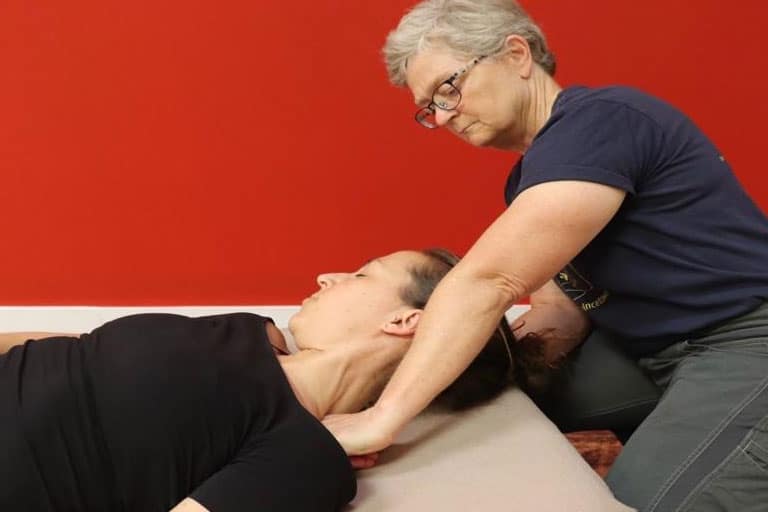
LOU BENSON
Lou Benson is the retired Education Director and former lead teacher for all levels of ATSI worldwide.
ONE DAY SMALL GROUP MENTORSHIP
This is a one day small group mentorship for Structural integration practitioners. This is an exceptional opportunity to study with Lou Benson. You are required to book early as it will be on a first come, first served basis with limited numbers.
“Deep work” is a term that comes up often among manual therapists, but what does it really mean?
For many people, clients even more than therapists, deeper work implies greater pressure. This was certainly true in my first years of practice, but over the years, depth has come to have much more to do with refining perception than force.
It is about becoming increasingly sensitive and responsive to the person in front of us, developing the ability to hold multiple layers of information simultaneously – structural, physiological, neurological, emotional, and experiential.
As our perception deepens, so does our capacity to distinguish what we are feeling, to recognise patterns rather than isolated symptoms, and to respond with greater precision and less effort. Ironically, the deeper we go, the less we often need to do.
In this workshop, Lou Benson shares some of the most meaningful learning experiences from her 35 years as a Manual Therapist and Structural Integration Practitioner.
She says “these experiences have transformed not only how I work, but how I understand the therapeutic relationship. They have helped me remain curious, engaged, and passionate about this work, while also protecting me from the burnout and body-mechanics-related injuries that are so common in our profession.”
Together, you will explore how depth emerges through refined attention, skilled touch, and a willingness to continually listen, learn, and adapt.
CONCEPTS COVERED INCLUDE:
Turning and tuning the “systems kaleidoscope” – learning to shift focus between fascial, fluid, neural, and structural relationships.
Refining touch to evaluate, differentiate, and respond to tissues with greater specificity. Shifting focus seamlessly between a “touching touch” and a “doing touch.”
The importance of second hand work: stabilising the working layer
Using your whole body as both a sensory instrument and an efficient mechanical tool.
Using palpation in and out of gravity as a guide for assessment and session strategy.
Understanding the spoken and unspoken dialogues between practitioner and client, and how presence influences outcomes. Feeling seen, but not too much.
Client homework and self-care strategies that help positive changes integrate and persist beyond the treatment room.
This class is an invitation to slow down, sharpen perception, and discover that going deeper is not about doing more – it is about seeing, feeling, and understanding more.
1 DAY WORKSHOP: $579
The Pelvic Diaphragm Workshop
3 – 4 March 2027 with Julie Hammond
For manual therapists and movement practitioners
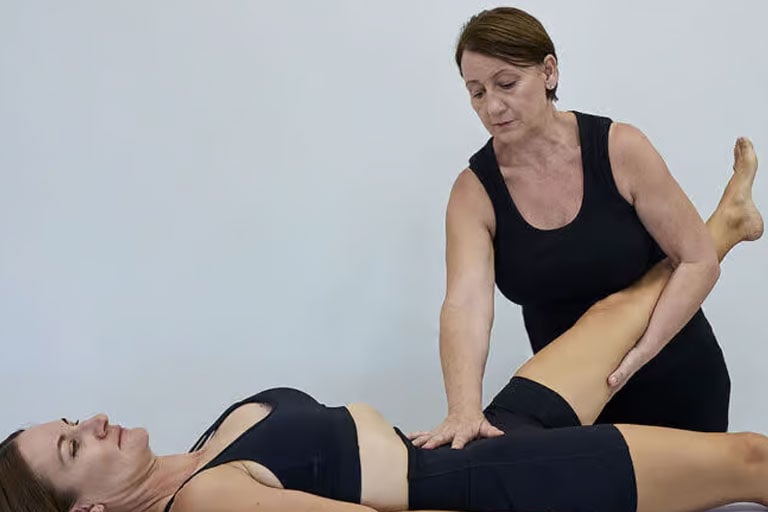
JULIE HAMMOND
Julie Hammond, BSc(Hum&MedSc) is the Director and Lead Teacher of Anatomy Trains Australia & New Zealand.
TWO DAY WORKSHOP
The Pelvic Diaphragm Workshop is based on the book, The Pelvic Diaphragm: Treating Pain and Dysfunction from a Global Anatomical Perspective by Julie Hammond.
In this two-day workshop, we will take a deep dive into the intricate and complex local anatomy of both the male and female pelvis and pelvic diaphragm from the perineum to the fascial diaphragm of the endopelvic fascia.
Once the local anatomy is understood, it is vital to appreciate how it fits into a global context. The pelvis is balanced within a larger global tensegrity structure. There are fascial and functional connections between the pelvic diaphragm and the respiratory diaphragm, as well as a functional relationship with the feet and ankles.
There is a clear link between the ankle and pelvic positions, which affects the pelvic diaphragm within.
The workshop will incorporate the latest research on these connections and their relevance to clinical practice. Making sure the pelvis has adequate support above and below before easing tension in the pelvic diaphragm, so the client can maintain the changes.
The aim is to inspire and excite students by making misunderstood, complex anatomy relatable. The focus is on the fascial connections between the pelvic diaphragm and respiratory diaphragm, introducing newer anatomical concepts. This is supported by current research that can inform clinical practice.
Clear guidelines are provided, including fascial release techniques, self-release (client homework), and experiential activities.
NOTE: A pair of FAMO Massage Balls and a Tune Up Fitness® Coregeous® ball is included for each participant.
2-DAY WORKSHOP: $1,100
EARLY BIRD OFFER: Register for $1,000 before 17 September 2026