Anatomy Trains for Performance
BY CHRIS CLAYTON I use both Anatomy Trains Structural Integration and Anatomy Trains for Performance (ATP) concepts and training when working with clients, depending on what they need. One thing that always stands out clearly is that every client that I can get back into movement, regardless of how small, controlled or measured that movement is, has always turned the corner towards recovery and better performance.

Momentum
BY CHRIS CLAYTON Momentum is at the very centre of our human existence. Throughout history, humankind has needed to maintain some form of momentum to keep moving forward using various methods of movement to find food, shelter and what we need to survive...
Being Human
BY JULIE HAMMOND We all breathe without even thinking about it, on average, 12-18 breaths a minute. However, the complexity yet simplicity of the anatomy that allows this to happen is fantastic. From the beautiful fluid respiratory diaphragm to the lungs and their double-bagged fascia that suction them to the wall of the thoracic cavity and allow expansion on inhalation...

Getting our Heads on Straight
BY CHRIS CLAYTON Our cervical spine supports our neuro and viscerocranium that contains the brain and its meninges, including the visual cortex, Hippocampus, Parietal cortex, and all of the other amazing elements of the brain anatomy. The cervical spine also provides the structure that supports the viscera of the neck, Pharynx, oesophagus, arteries, veins and very large bundles of nerves...
Taking a Weight off our Shoulders
BY CHRIS CLAYTON Our shoulders and arms can perform great feats of strength and athleticism, and yet they also enable us to paint, dance and help us express our inner selves. Although, as I have gotten older, I have realised that some of that training was not conducted with the aging process in mind...
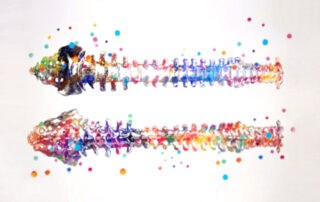
Our Spine: A Column of Resilience and Endurance
BY CHRIS CLAYTON As individuals and therapists, we should never underestimate the painful effect of compensatory patterns involving soft tissue and their impact on our overall spinal health. Clients that have had a scan and received a result indicating no structural issue with their spine, or nothing of great note. Yet, they still may be enduring lower back pain, or pain somewhere along the spinal column...

Standing on the Shoulders of Giants
BY JULIE HAMMOND Sir Isaac Newton said, “If I have seen further, it is by standing on the shoulders of giants”, this phrase should remind us that everything we see and achieve is only possible because of the work of people before us. It’s about acknowledging the work that has led us to what we have discovered, it’s about shared learning for the bigger picture...

Opening the Breath
BY CHRIS CLAYTON Breath is an obvious part of everything we do, yet many of us are always trying to catch it in some way. Its very nature is elusive, you cannot hold or grasp breath? Yet we can contain and literally embody it, so much so that we have an apparatus that does miraculous things with breath. Our respiratory system is simply a sensational masterpiece...
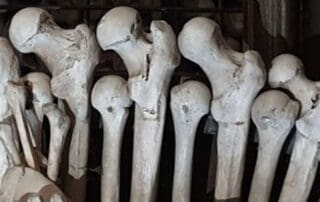
The Hip: A Balance of Range and Stability
BY CHRIS CLAYTON What we took away from the Sedlec Ossuary, which was a very clear confirmation of the varied individualised nature of our skeletal composition – even if it appears to be minor it is very noteworthy. Contemplating all of this would leave us thinking that treating the hip and body as a whole is a complex jigsaw puzzle of pains, patterns and posture...

Pelvic and Respiratory Diaphragm Connection
BY JULIE HAMMOND We all know the respiratory diaphragm is the main muscle of respiration, but it is a coordinated event with other structures in the body, in particular the pelvic diaphragm. Anybody who has attended my workshops knows that I like to think of the respiratory diaphragm like a jellyfish contracting and relaxing with fluidity within the body...